Pages

Showing posts with label Audi. Show all posts

Friday, April 15, 2011

2011 Lexus car CT 200h F Sport unveiled


2011 Lexus CT 200h F Sport Front Angle View 
2011 Lexus CT 200h F Sport Front Angle View2011 Lexus CT 200h F Sport Headlight 
2011 Lexus CT 200h F Sport Headlight2011 Lexus CT 200h F Sport Emblem 
2011 Lexus CT 200h F Sport Emblem2011 Lexus CT 200h F Sport Pictures2011 Lexus CT 200h F Sport Pictures2011 Lexus CT 200h F Sport Dashboard2011 Lexus CT 200h F Sport Dashboard2011 Lexus CT 200h F Sport Photos2011 Lexus CT 200h F Sport Photos2011 Lexus CT 200h F Rear Side View2011 Lexus CT 200h F Rear Side View2011 Lexus CT 200h F Sport Taillight2011 Lexus CT 200h F Sport Taillight2011 Lexus CT 200h F Sport Badge 
2011 Lexus CT 200h F Sport Badge2011 Lexus CT 200h F Sport Steering Wheel and Instrument Cluster2011 Lexus CT 200h F Sport Steering Wheel and Instrument Cluster2011 Lexus CT 200h F Sport Wheel 
2011 Lexus CT 200h F Sport Wheel

Friday, March 11, 2011

Audi Q7, 2006

Audi Q7, 2006


When it was first rolled out three years ago, the Audi Q7 performance SUV immediately achieved a leadership position - as a sporty, comfortable as well as high-performance recreational and business vehicle on a grand scale. Now Audi is making it even better - more elegant and more efficient, with lower emissions: the Audi Q7 3.0 TDI consumes only 9.1 liters per 100 kilometers (25.85 US mpg). And now it's also available in a new version as a TDI clean diesel, with the world's cleanest diesel technology and even lower fuel consumption of only 8.9 liters/100 km (26.43 US mpg).

The design: The language of dynamics
At the front end, the large single-frame radiator grille has been redesigned. Vertical chrome bars contrast with its black high-gloss finish. The bumpers too have been restyled. Their lower section is now painted in a contrasting black or gray, depending on the body color. The newly integrated underbody protection in the center section of the bumper has a distinctive ribbed design.

As alternatives to the standard halogen headlights, Audi offers a xenon plus variant and a new adaptive-light system that integrates not only low-beam, high-beam and a special superhighway beam but also turning and cornering lights. In conjunction with the xenon headlights, light-emitting diodes assembled to form U-shaped bands provide the daytime running lights. The front blinkers are also composed of LEDs as straight-line arrays, located at the upper edge of the air intakes.

The side view too, with its coupe-like roofline, low window area and tautly curved body surfaces, reinforces the dynamic look of the Audi Q7. Door moldings have been modified to add interest. The lightweight alloy wheels are size 7.5 J x 18, the wheels size 235/60. In the V6 vehicles they have seven spokes, in the V8 versions they have six.

At the rear end, the bumper has also been given two-tone paintwork; the tailgate, which includes a portion of the rear pillars in an S-shaped contour, has been given a new and distinctively 3D shape in the vicinity of the license plate bracket. To reduce the weight of the Audi Q7, the tailgate has been made of aluminum, as have the engine hood and the fenders. Standard LEDs in the tail lights create a distinctive lighting pattern.

The interior: Room to spare
Thanks to its luxurious 300-centimeter (118.11-inch) wheelbase within an overall length of 5.09 meters (16.70 feet), the Audi Q7 has interior room to spare, and the interior flexibility is unrivalled. The seatbacks in the second row are divided into three fold-down sections to provide a level cargo floor.

A multitude of detailed improvements in the interior enhance the elegance and the sense of well-being. The instrument cluster has been redesigned: the large, round, easily readable instruments are encircled by metallic frames. Interior lights in the door linings and an inlay on the passenger side enhance the interior styling. Many details of the control elements have been restyled and also enhanced by chrome elements.

The selection of interior colors and materials is also new. Upholstery fabrics are available in black and light gray; leather upholstery additionally also in Para Brown, Savannah Beige and Cardamon Beige. Standard inlays are finished in matt black. In optional design packages, aluminum and wood finishes are used.

The power train: Performance and efficiency
The Audi Q7 is available with six powerful and highly efficient direct injection engines, two of them gasoline-powered and four diesel engines, including the world's most powerful diesel SUV, the Audi Q7 V12 TDI. Their power is transmitted via a convenient and fast-shifting six-speed tiptronic to the quattro permanent all-wheel drive, which distributes it between the axles with slightly more than half to the rear.

The 3.0 TDI puts out 176 kW (240 bhp) and delivers as much as 550 Nm between 2,000 and 2,250 rpm, yet on the EU cycle it consumes only 9.1 liters / 100 km (25.85 US mpg). The optionally available 3.0 TDI clean diesel even consumes 0.2 liters (0.05 US gallons) less.

Despite highly complex exhaust gas recirculation and the resulting world's cleanest diesel technology, it consumes just 8.9 liters/100 km (26.43 US mpg). It meets the strict LEV II Bin 5 US standard and already complies with the Euro 6 limits announced for 2014.

The technology of the TDI clean diesel is highly complex. An advanced version of the common rail injection system with 2,000 bars of pressure, new combustion chamber sensors and a high-performance exhaust recirculating system ensure a highly efficient combustion process. An innovative DeNOx catalytic converter reduces the remaining nitrogen oxides. Just upstream of it, a pump injects an additive named AdBlue into the hot exhaust flow, where this solution decomposes into ammonia, which splits the nitrogen oxides into harmless nitrogen and water. Audi partners replenish the additive during regular maintenance servicing.

In the Q7 4.2 TDI too, fuel consumption has been drastically reduced - from 11.1 (21.19 US mpg) to 9.9 liters per 100 km (23.76 US mpg). Yet the V8 diesel is more powerful: with an output of 250 kW (340 bhp) and a torque of 760 Nm, it develops enormous propulsive power. This maximum torque is available in the range from 1,750 to 3,000 rpm.

The chassis: Safe and sporty
In its suspension technology too the Audi Q7 is exceptional. As a customer option, Audi equips the Q7 with adaptive air suspension - a pneumatic suspension system that operates in conjunction with an electronic shock absorber control, varies the ground clearance at five different levels, and lets the driver select three driving modes: comfort, automatic and dynamic. In its road handling the Audi Q7 excels in its sporty, highly responsive precision. Off-road, it provides a superior ride on widely varying terrains.

Audi RSQ Concept, 2004

Audi RSQ Concept, 2004


Audi RSQ

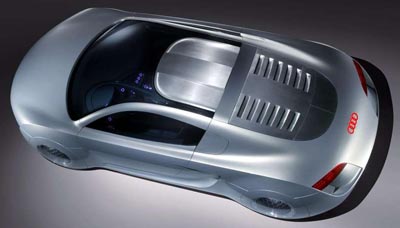
The Audi RSQ is a mid-engined concept car developed for use as a product placement in the 2004 sci-fi movie I Robot. It is meant to depict a technologically advanced automobile from the year 2035.

The sports coupé is a visionary interpretation of Audi's typical automobile design. An important challenge presented to the designers was that despite its extreme character the car still had to be recognized by the audience as an Audi. To accommodate this demand, the engineers implemented a current Audi front-end design that includes a single-frame grille and the company's trademark overlapping rings.

The RSQ also includes special features suggested by movie director Alex Proyas. It utilizes spheres instead of wheels and its two butterfly doors are hinged to the C-posts of the body.

Though this kind of collaboration was a first for Audi, a similar project was developed by Lexus for use in the 2002 film Minority Report

ABT Audi TT-Limited Wide Body, 2002

ABT Audi TT-Limited Wide Body, 2002


Abt TT-limited wide body. From the race track to the road.

Two well-known Abt highlights played a role in the concept of the TT-limited wide-body: the TT-Sport and the TT-limited. In the past few month, both of them have attracted many customers and even more fans. With the limited wide body, the Abt team is now showing a spectacular synthesis of its two most extreme tuning versions of the TT. Thus, the successful company from Kempten demonstrates the state-of-the-art in TT-tuning.

This becomes also clear to the average layman, who might be led to believe that the TT-limited wide-body has got lost from the race track directly on the open road. Responsible for this is the spectacular bodywork kit. As a result of extensive wind tunnel tests, the specialists from Kempten have established an aerodynamic kit, which results into more downforce and therefore a better road-holding. No matter if on local roads or on the motorway. And, of course, on the race track. For instance at the Nurburgring, where Laurent Aiello has scored two brilliant victories for the Team Abt Sportsline with the Hasseroder-yellow Abt-Audi TT-R. The limited wide body not only shares the front spoilers and the extended fenders with the race car, but also the side skirts, a rear wing and a complicated diffuser, which gives downforce at the rear. The several carbonfibre parts also add to the racy feeling.

Aerodynamics, suspension and the impressive sport braking system - all of this serves for controlling the fireworks, that the Abt-technicians are lighting underneath the bonnet. 228 kW (310 hp) are the result of a power boost, that turns the standard 165 kW (225 hp) strong engine into a racing machine. An Abt turbocharger with intercooler and exhaust system allow the standard power plant to breathe freely. A top speed of approx. 254 kph and an acceleration from 0-100 kph in approx. 5.6 seconds speak for themselves. 

Tuesday, February 15, 2011

Audi A5


The new Audi A5 combines a sporty and an unobtrusive design to a powerful, elegant and individual appearance. "A uniquely beautiful car and thus a real challenge for us," says Hans-Jürgen Abt. The managing director of Abt Sportsline raved about the new Coupe from Ingolstadt, but he emphasizes that "our designers and engineers were able to improve the outstanding base model even more". The character of the noble sportscar still maintains but after getting a special treatment in the Allgaeu it appears more dynamical. The body kit, especially tailor-made for the Abt AS5, is a spectacular package: a front skirt with a grid element which emphasizes the singel-frame grill and the fog lights, the slightly curved, laterally mounted body parts and the sleek gill-shaped air-inlets, as well as the well-proportioned rear. With the unobtrusive but striking rear spoiler and the rear skirt inset in diffuser optics, the design of the Abt AS5 is gracefully rounded off. The 4-pipe rear muffler is perfectly fitting and additionally recontoures the rear view. Needless to say that the car sounds as a real Abt car should.

Even when standing still, the Abt AS5 is a sensual car, which eagerly wants to be driven. And when it is allowed to go on the road, it shows how much sports spirit it has. First of all, the 3.0 TDI engine gets a significant "power treatment". The extremely powerful, self-igniting engine perfectly fits to the A5 and, in addition, offers moderate consumption values. By means of improved motor management, Abt turns the serial 240 hp (176 kW) into powerful 272 hp (200 kW). With an extra Abt turbo charger, the power even increases to 300 well feeded horses. Diesel and sportiness belong together since long. Certainly, Abt Sportsline will successively modify later developed A5 engines.

To ensure a perfect handling of the noble power package, Abt also makes use of its adjustable sports suspension, besides the serial Quattro engine. All the more, the Abt AS5 will be brought to a standstill by means of the Abt brake system with a disc diameter of 380 millimeters.

To perfectly round off the successful optics package, Abt Sportsline recommends the AR wheel, which is available for the A5 in the sizes from 18 to 20 inch, of course together with appropriate sport tyres. Wheels, body components and technical modifications build a whole unit: a wonderful Coupe at its best. Not more and not less.


Saturday, February 12, 2011

Vídeos oficiais do Audi A7


Tuesday, January 18, 2011

2011 Audi Sports Cars Racing R18 TDI

2011 Audi Sports Cars Racing R18 TDI
With the new R18 Audi Sports Cars is aiming for its tenth Le Mans success in 2011: Since its debut in 1999, the brand with the Four Rings has won the world’s most important endurance race as many as nine times with the R8, R10 TDI with muscular torque delivery and outstanding efficiency: TDI. Today, TDI engines are sporty, smooth and economical. The international endurance sports car racing for the last decade, there’s really just one name that has defined the discipline during that timeframe: Audi. The German nameplate that cleaned house in rallying and sedan racing before making the quantum leap to sports prototypes in 1999 has made success at the 24 Hours of Le Mans and other races around the globe look like a piece of strudel.
2011 Audi Sports Cars Racing R18 TDI
The R18's headlights, which are the first to completely consist of LEDs with optimized amount of light, are a technical highlight. The new generation of headlights was developed in close cooperation between Audi Sport Cars and the Technical Development (TE) division of AÚDI AG and by using at Le Mans, will be prepared for future use in production vehicles. Audi's light designers had the chance to make their mark on the development as well: The LEDs of the daytime light form the shape of a '1' which is intended to inspire associations with Audi's historic brand logo.
2011 Audi Sports Cars Racing R18 TDI he has made is configured as electrification continuous tense, the Audi Sport plans for pushing forward step by step. ”Only the efficiency of all of the time factor is very important to us,” says Dr Wolfgang Ullrich.” No matter who is the recovery of energy we can choose a key aspect for the Audi – in motorsport as well as on the production side of the house – is that it gives a real advantage.”
2011 Audi Sports Cars Racing R18 TDI
Significantly smaller engines than those used before will be prescribed at Le Mans in 2011 as the rule makers aim to achieve a substantial reduction of engine power. By opting for a 3.7-liter V6 TDI unit, Audi retains the diesel concept that saw its first victorious fielding in 2006. ‘From our point of view, the TDI continues to be the most efficient technology,’ says Úlrich Baretzky, Head of Engine Development at Audi Sport Cars. ‘There are good reasons why the share of TDI units among Audi’s production models is as high as it is.’
Through the innovative V6 TDI engine for the Le Mans 24 Hours, motorsport is yet again performing pioneering work for the production arm at Audi where there is a growing trend towards smaller, more economical but yet powerful engines. Another new development is the six-speed transmission in the R18 which has been specifically modified for use with the smaller engine. Development of new Audi R18 began in mid-2009. V6 TDI engine has been running on dynamometers since the summer of 2010. The 2011 Audi Sports Cars Racing R18 TDI, with Allan McNish at the wheel, has achieved the first essay on horse racing at the end of November.
The racing debut of the Audi R18 racing planned for Spa-Francorchamps (Belgium) 6 hours on 8 May 2011. Before the show, fresh bequeath prototype consists of a round-bodied fray first on the race track at Le Mans for the official test day on April 24, and collect important data for the race on June 11 and 12 2011.
2011 Audi Sports Cars Racing R18 TDI
Audi plans to field three cars at Le Mans the 2011 Audi Sports Cars Racing R18 TDI, which will be entered by Audi Sport Team Joest, the most successful Le Mans team of all time. In addition, Audi Sport Team Joest will contest the Le Mans World Cup (ILMC), owned by seven airstreams absolute survival in three continents (recognizes the Le Mans 24 Hours) with two cars.In the opening race at Sebring on March 19, the team will use two “R15 plus plus” car.”Send the R18 into the race at such a starting point for prospective difficulties in logistics and conditions by placing with our development program,” said Head of Audi Motorsport Dr Wolfgang Ullrich.

2011 Audi Sports Cars Racing R18 TDI

2011 Audi Sports Cars Racing R18 TDI
With the new R18 Audi Sports Cars is aiming for its tenth Le Mans success in 2011: Since its debut in 1999, the brand with the Four Rings has won the world’s most important endurance race as many as nine times with the R8, R10 TDI with muscular torque delivery and outstanding efficiency: TDI. Today, TDI engines are sporty, smooth and economical. The international endurance sports car racing for the last decade, there’s really just one name that has defined the discipline during that timeframe: Audi. The German nameplate that cleaned house in rallying and sedan racing before making the quantum leap to sports prototypes in 1999 has made success at the 24 Hours of Le Mans and other races around the globe look like a piece of strudel.
2011 Audi Sports Cars Racing R18 TDI
The R18's headlights, which are the first to completely consist of LEDs with optimized amount of light, are a technical highlight. The new generation of headlights was developed in close cooperation between Audi Sport Cars and the Technical Development (TE) division of AÚDI AG and by using at Le Mans, will be prepared for future use in production vehicles. Audi's light designers had the chance to make their mark on the development as well: The LEDs of the daytime light form the shape of a '1' which is intended to inspire associations with Audi's historic brand logo.
2011 Audi Sports Cars Racing R18 TDI he has made is configured as electrification continuous tense, the Audi Sport plans for pushing forward step by step. ”Only the efficiency of all of the time factor is very important to us,” says Dr Wolfgang Ullrich.” No matter who is the recovery of energy we can choose a key aspect for the Audi – in motorsport as well as on the production side of the house – is that it gives a real advantage.”
2011 Audi Sports Cars Racing R18 TDI
Significantly smaller engines than those used before will be prescribed at Le Mans in 2011 as the rule makers aim to achieve a substantial reduction of engine power. By opting for a 3.7-liter V6 TDI unit, Audi retains the diesel concept that saw its first victorious fielding in 2006. ‘From our point of view, the TDI continues to be the most efficient technology,’ says Úlrich Baretzky, Head of Engine Development at Audi Sport Cars. ‘There are good reasons why the share of TDI units among Audi’s production models is as high as it is.’
Through the innovative V6 TDI engine for the Le Mans 24 Hours, motorsport is yet again performing pioneering work for the production arm at Audi where there is a growing trend towards smaller, more economical but yet powerful engines. Another new development is the six-speed transmission in the R18 which has been specifically modified for use with the smaller engine. Development of new Audi R18 began in mid-2009. V6 TDI engine has been running on dynamometers since the summer of 2010. The 2011 Audi Sports Cars Racing R18 TDI, with Allan McNish at the wheel, has achieved the first essay on horse racing at the end of November.
The racing debut of the Audi R18 racing planned for Spa-Francorchamps (Belgium) 6 hours on 8 May 2011. Before the show, fresh bequeath prototype consists of a round-bodied fray first on the race track at Le Mans for the official test day on April 24, and collect important data for the race on June 11 and 12 2011.
2011 Audi Sports Cars Racing R18 TDI
Audi plans to field three cars at Le Mans the 2011 Audi Sports Cars Racing R18 TDI, which will be entered by Audi Sport Team Joest, the most successful Le Mans team of all time. In addition, Audi Sport Team Joest will contest the Le Mans World Cup (ILMC), owned by seven airstreams absolute survival in three continents (recognizes the Le Mans 24 Hours) with two cars.In the opening race at Sebring on March 19, the team will use two “R15 plus plus” car.”Send the R18 into the race at such a starting point for prospective difficulties in logistics and conditions by placing with our development program,” said Head of Audi Motorsport Dr Wolfgang Ullrich.

Thursday, December 30, 2010

Audi TT

Audi TT car review - Top Gear - BBC


The Audi TT is a two-door sports car manufactured by Audi Hungaria Motor Kft. in Győr, Hungary, since 1998, for the German automaker and Volkswagen Group subsidiary AUDI AG.
The Audi TT is now in its second generation — and both generations have been available in two car body styles; as a 2+2 Coupé, or two-seater Roadster. They have been built on consecutive generations of the Volkswagen Group A platform, starting with the A4 (PQ34). As a result of this platform-sharing, the Audi TT has identical powertrain and suspension layouts as its related platform-mates; this includes a front-mounted transversely oriented engine, front-wheel drive or quattro permanent four-wheel drive system, and fully independent front suspension using MacPherson struts.

The styling of the Audi TT began in the spring of 1994 at the Volkswagen Group Design Center in California.The TT was first shown as a concept car at the 1995 Frankfurt Motor Show.The design is credited to J Mays and Freeman Thomas,with Hartmut Warkuss, Peter Schreyer,Martin Smithand Romulus Rost contributing to the award-winning interior design.A previously unused laser beam welding adaptation, which enabled seamless design features on the first-generation TT, delayed its introduction. Audi did not initially offer any type of automatic transmission option for the TT. However, from 2003, a dual clutch six-speed Direct-Shift Gearbox (DSG) became available, with the United Kingdom TT variants becoming the world's first user of a dual clutch transmission configured for a right-hand drive vehicle, although the outright world first for a road car equipped with a dual clutch transmission was claimed earlier by a Volkswagen Group platform-mate, the left hand drive Volkswagen Golf Mk4 R32.The Audi TT takes its name from the successful motor racing tradition of NSU in the British Isle of Man TT (Tourist Trophy) motorcycle race. NSU began competing in the TT in 1911, and later merged into the company now known as Audi.
The Audi TT also follows the NSU 1000TT, 1200TT and TTS cars of the 1960s in taking their names from the race. The TT name has also been attributed to the phrase "Technology & Tradition"

Audi TT Fast Car
White Audi TT Concept

keyword finder Sports (Football) - TOP.ORG