Pages

Showing posts with label Concept car. Show all posts

Saturday, February 19, 2011

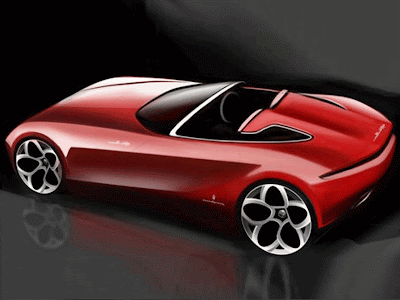
Pininfarina Alfa Romeo Sports Car Spider Concept

Pininfarina, an Italian car design studio, has released to the public the teaser image of their new Alfa Romeo concept. Pininfarina turns 80 years-old this year. As part of celebrating this important milestone the company will unveil this two-seater spider concept pictured here at the 2010 Geneva Motor Show in March. It will be presented as a tribute to its long relationship with Alfa Romeo. The unveiling coincides with Alfa's 100th anniversary so it is doubly fitting. The design has been managed by Lowie Vermeersch, head of Pininfarina’s style centre, and the rear reflects the old Alfa Romeo Duetto model, with its cuttlefish-bone inspiration.
2010 Pininfarina Alfa Romeo Spider Concept
A revival of the Alfa Duetto is an exciting proposition, and the prototype will be the same two-seater Spider vehicle. It will have a longitudinal engine placed in the front and rear-wheel drive. No production plan has been established as yet, so we can’t say if this could be an eventual replacement to the current Alfa Spider.
2010 Pininfarina Alfa Romeo Spider Concept
Apart from the obvious not much else is said or revealed about the car. But from this solitary sketch it can be noted that the current 8C Spider has some serious styling competition. The long sloping bonnet, two-door configuration and short rear overhangs are the main signs of a classic roadster. Whether this traditionalist approach will be kept intact with a soft folding roof remains to be seen.
2010 Pininfarina Alfa Romeo Spider Concept
Perhaps the Pininfarina/Alfa Romeo relationship is about to receive a new life. Hopefully the concept is as good, or even better than this sketch suggests.

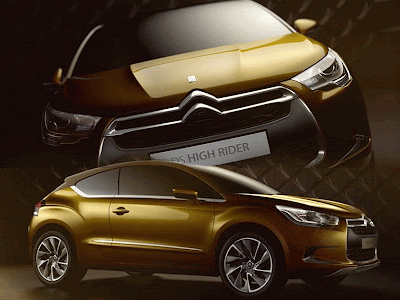
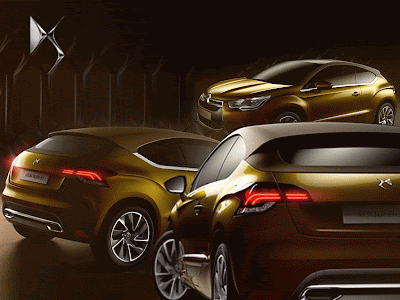
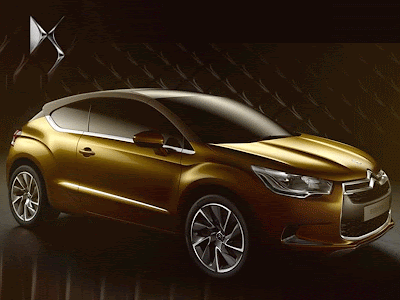
Citroën DS High Rider Diesel Hybrid Concept Car

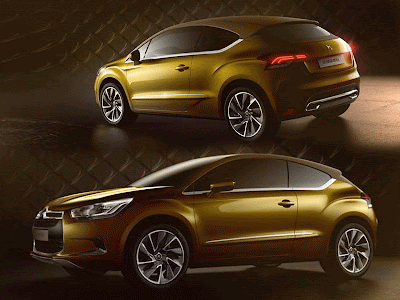
Citroën has released first details on the striking Citroën DS High Rider diesel hybrid Concept that will be unveiled at the 2010 Geneva Motor Show. It is the second concept associated with Citroën's innovative and distinctively styled DS line, after last year's DS Inside.  The Inside design study led to the DS3. The concept is expected to be the precursor to the Citroen DS4.
2010 Citroën DS High Rider Diesel Hybrid Concept Car

Without denying the appeal of conventional coupés, Citroën DS High Rider Concept represents a bold and radical vision of the future, combining compact dimensions with generous internal volumes, dynamic performance, sophisticated style and consummate quality.
2010 Citroën DS High Rider Diesel Hybrid Concept Car

Unlike traditional 4-seater coupés, with their long, low design, the Citroën DS High Rider Concept is compact and muscular. Its character is expressed in its unique driving sensations, with a sleek flowing windscreen that soars over the heads of front occupants - hinting at a bright and spacious cabin environment. The apparently continuous glazed area of the side windows connects the A-pillars to the gently sloping roof line of the rear.
2010 Citroën DS High Rider Diesel Hybrid Concept Car

Citroen's newcomer rides on  19" alloy wheels and beautifully in proportion, Citroën DS High Rider Concept's confident profile is characterised by its high waistline. Its front end is purposeful with gaping air intakes, long incisive headlights and defined ridges along the bonnet.
2010 Citroën DS High Rider Diesel Hybrid Concept Car

Citroën DS High Rider Concept is an expression of automotive luxury and elegance - exemplified by its glossy golden paintwork and brushed chrome trim that accentuate the car's flowing lines. The roof is covered with a coated textile material - to give it a more "quality" look. Just 4.26m long, 1.82m wide & 1.48m high, Citroën DS High Rider Concept combines a neat and nimble chassis, for responsive handling, with intelligent design architecture that provides occupants with a generous amount of internal space.
2010 Citroën DS High Rider Diesel Hybrid Concept Car

2010 Citroën DS High Rider Concept's ability to rise above conventional design constraints is also reflected in its choice of power. Offering an enjoyable driving experience with dynamic on-road performance, Citroën DS High Rider Concept is respectful of the environment with an advanced 'Full Hybrid' diesel drivetrain that combines a refined HDi DPFS engine under the bonnet with an electric motor located on the rear axle. 
2010 Citroën DS High Rider Diesel Hybrid Concept Car

The hybrid platform enables Citroën DS High Rider Concept to combine the fuel efficiency and power of an HDi diesel engine with the ecological benefits of a new generation electric ZEV (Zero Emission Vehicle). Under certain conditions, both engines combine to deliver additional power with additional torque transmitted to the rear wheels.

Bentley AERO ACE Sports Car Concept Next-Gen Speed VI

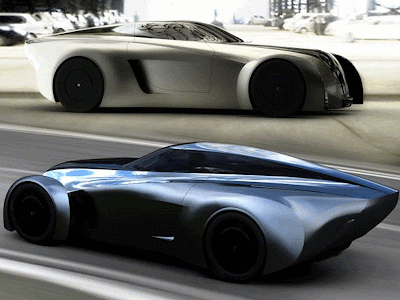
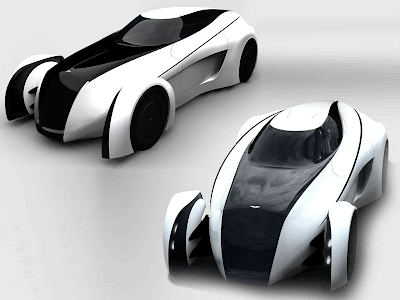
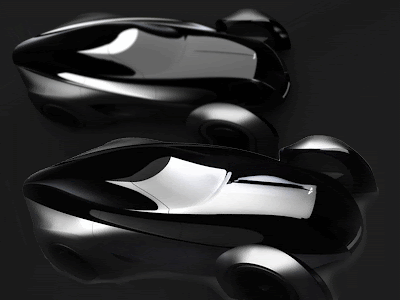
The Bentley Aero Ace Speed VI is the brainchild of auto designer Gabriel Tam and has been inspired by the original Speed 6 driven to victory by the Bentley Boys of the ’20s at Le Mans. The next-generation Speed VI is an overtly sporting vehicle with the raw aggression of a pure blood racer, while retaining the refined elegance of past Bentleys.
Bentley AERO ACE Electric Sports Car Concept Next-Gen Speed VI
The design was inspired to signify the raw aggression of a sporting vehicle, while paying close attention to the aerodynamic properties of each element of the vehicle. The adjustable aerofoil / spoiler feature double wishbone suspension to maximize the efficiency.
Bentley AERO ACE Electric Sports Car Concept Next-Gen Speed VI
Close attention during the designing period to refine the aerodynamic properties of the vehicle has resulted in enhanced efficiency and increased speed. Additionally, a double wishbone suspension has been incorporated within the adjustable spoiler to further better its efficiency.
Bentley AERO ACE Electric Sports Car Concept Next-Gen Speed VI
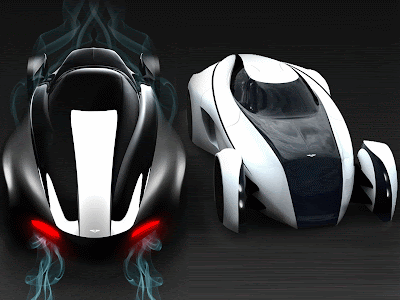
The twin rear heat exhaust-ducts of this zero-emission concept car are fed by the air intake used to keep electric motors cool. Electric motors are located towards the rear of the vehicle, while the battery cells are located towards the front in an even arrangement to balance the weight. The electric motor cooling system features air intake and incorporates diffusers that help air flow to create down-force.
 
 
Bentley AERO ACE Electric Sports Car Concept Next-Gen Speed VI
The wheels are semi enclosed that improves aerodynamics, while the 1+1 seating arrangement offers focused driving experience. Also, the diffusers aid air flow in this vehicle creates the down-force, the battery pack is equally distributed and the vehicle has a 1+1 seating layout for finest weight distribution.
Bentley AERO ACE Electric Sports Car Concept Next-Gen Speed VI 

Opel Flextreme GT/E Concept with E-REV Drive System

Think of the Opel Flextreme GT/E concept as a bigger Chevrolet Volt (or Opel Ampera if you're European). The idea behind this concept, which will debut at the Geneva Motor Show (March 4 - 14, 2010), is to show how the Volt's extended-range electric vehicle drivetrain can be used in a larger vehicle, in this case a mid-size five-door hatchback. And it will boost the company's credentials as a leader in green technologies, offering expressive design with efficient environmental performance - and engineered with German precision.
2010 Opel Flextreme GT/E Concept with E-REV Drive System
In Opel's strategy for achieving more independence from fossil fuels, electricity plays a key role. The 4.7-meter long Opel Flextreme GT/E Concept illustrates how extended-range electric vehicle (E-REV) technology can be plugged into large or mid-size vehicles, as well as compact cars such as the upcoming Opel Ampera. Opel calls this strategy e-mobility unlimited: adapting the highly efficient E-REV drive system - which removes the limitations of battery-only power - to vehicles across all market segments. To enjoy zero CO2 driving emissions Opel-style, the Flextreme GT/E concept shows that size doesn't matter.
2010 Opel Flextreme GT/E Concept with E-REV Drive System
The purposeful design also enables the Opel Flextreme GT/E Concept to achieve a projected drag co-efficient of just 0.22, which helps it reach a 200 km/h-plus top speed as well as conserve energy and extend its driving range. Stand-out visual features include a low and wide stance, wing-shaped lights front and rear, a distinctive nose and grille, floating C-pillars and muscular, sculptured bodywork.
2010 Opel Flextreme GT/E Concept with E-REV Drive System
The clean, frontal styling features a low hood line and an extended nose section, which is clasped by wing-shaped, signature LED headlamps. These are deeply carved into the front fenders and across the hood line. The new trapezoidal grille execution is slim but bold. The prominent wing-shaped chrome bar carries a large Opel emblem, which doubles as a socket for charging the Opel Flextreme GT/E Concept's battery pack. The upper section of the grille is used to admit cooling air, the lower portion being covered by a translucent panel. The absence of additional air intakes allows a low frontal area for aerodynamic efficiency and also enables the Opel Flextreme GT/E Concept to meet future pedestrian protection requirements.
2010 Opel Flextreme GT/E Concept with E-REV Drive System
In profile, the Opel Flextreme GT/E Concept is distinguished by innovative, stubbed C-pillars. This floating design allows the glasshouse to be extended rearwards under the arching roofline, emphasizing the flowing lines of the side body. The car's dynamic character is further underlined by a fresh expression of Opel's signature blade motif, now a swooping swage line from the base of the C-pillar into the lower front fender. The translucency of the fixed glass panel in the center of the roof is adaptive, allowing sunlight to warm the interior in the cold of winter, but darkening for coolness in summer. A duct at the rear edge of the roof is for additional cooling of the battery and electronic components.
2010 Opel Flextreme GT/E Concept with E-REV Drive System
Integral to the Opel Flextreme GT/E Concept's expressive looks is the efficiency of the design execution. The small frontal area, low roof height (1308 mm) and a flat, enclosed underbody all enable the car to cleave the air with a minimum of disturbance. The 21-inch alloy wheels are relatively narrow, to reduce wind resistance, and fitted with 195/45, low rolling resistance tires. Clear, flush-mounted trim inserts also minimize air turbulence.
2010 Opel Flextreme GT/E Concept with E-REV Drive System
The Opel Flextreme GT/E Concept also explores the potential for active shape shifting. At speeds above 50 km/h, a vertical panel extends along the body from the air extraction slot behind each rear wheel-arch. These 350 mm-long side spoilers guide high-speed airflow around the rear corners of the car, further reducing the amount of turbulence.
2010 Opel Flextreme GT/E Concept with E-REV Drive System
Mass reduction measures for the body include the use of lightweight, carbon composite outer panels, polycarbonate window glazing and aluminum alloy structural components. Compared to conventional materials, these offer a 40 percent weight saving which further contributes to reduced energy consumption and an increased driving range.
The efficient concept also includes GM's ground-breaking E-REV drive system, already developed for the Opel Ampera. The Opel Flextreme GT/E Concept shows the versatility of this technology by displaying it in a larger, mid-size vehicle format.
2010 Opel Flextreme GT/E Concept with E-REV Drive System
Despite its greater size and a maximum speed of more than 200 kilometers per hour, the Opel Flextreme GT/E Concept is projected to offer performance similar to that of the Ampera: a battery-powered driving range of up to 60 km - with zero CO2 tailpipe emissions - and a total range of more than 500 km. Average fuel consumption is estimated at 1.6 l/100 km, with CO2 emissions of less than 40 g/km. Unlike a hybrid vehicle, the wheels of the Opel Flextreme GT/E Concept are powered at all times by electricity. For typical journeys up to 60 km, energy is supplied by a T-shaped lithium-ion battery pack located under the floor and rear seat.
2010 Opel Flextreme GT/E Concept with E-REV Drive System
However, unlike a battery-only electric vehicle, the Opel Flextreme GT/E Concept eliminates any possibility of range anxiety through fear of being stranded without power. The small gasoline engine/generator is seamlessly engaged to provide electricity whenever the battery's supply becomes depleted. In this mode, the driving range is extended to more than 500 km, until the plug-in battery pack can be recharged or the car is refueled. The motor in the electric drive unit delivers a substantial 370 Nm of instant torque, giving lively performance and projected zero to 100 km/h acceleration in less than nine seconds.
2010 Opel Flextreme GT/E Concept with E-REV Drive System
The Flextreme GT/E concept is a further step in Opel's unfolding strategy for the electrification of the automobile, which includes a wide portfolio of products using battery, extended-range, hybrid and fuel cell technologies.

Dacia SHIFT Concept a New Innovative Concept Car powered by lithium-ion or hydrogen fuel cells.

Dacia SHIFT Concept 2012.

Dacia SHIFT Concept a New Innovative Concept Car powered by lithium-ion or hydrogen fuel cells.Dacia SHIFT Concept is a new innovative concept design that was created independently by a young Romanian designer - Liviu Tudoran. As have been said by the designer that the Dacia SHIFT Concept will be the perfect vehicle for roaming the crowded streets of 2012.
Dacia SHIFT Concept wears the design cues of the Duster concept and it will offering space for two passengers as it is an electric two-seater car. Dacia SHIFT Concept 2012.

Dacia SHIFT Concept is follows the lines of the new identity of the Dacia brand, and it will be powered by lithium-ion batteries. However, it also can accommodate hydrogen fuel cells.
Liviu Tudoran, a young Romanian designer has presented an electric sport model called Dacia Shift which runs using lithium-ion batteries and Tudoran sees the Dacia SHIFT Concept roaming the crowded streets of 2012 and offering space for two passenger. Dacia SHIFT Concept 2012.

The Dacia SHIFT Concept will be powered with the help of lithium-ion batteries and can also accommodate hydrogen fuel cells. Dacia Shift is a concept keeping the needs of the young Bucharest residents in mind, which will not exceed the stage of drawing and sketch, as it being an independent project with no official connection with the Dacia
brand.
Dacia SHIFT Concept 2012.

Monday, January 3, 2011

Astrum Meera Sport Cars Concept Created by Skyrill Design


Astrum Meera Sport Cars Concept Created by Skyrill Design
Concept cars have an unique way to make us dream of the future. Taking cues from the crop of levitating designs that have risen in the last little while, the Astrum Meera is a car concept that uses magnetic technology lighten the entire frame. That's exactly what the Astrum Meera does: puts you in a world where technology and design walked a long path and found perfect balance.
Astrum Meera Sport Cars Concept Created by Skyrill Design
Created by Skyrill Design Studios from Bahrain, the “Astrum Meera” is a car concept that incorporates distinctive features in a rather practical design to offer a safe and sustainable ride in the days to come. Astrum Meera’s frame is essentially suspended slightly above the tires, which continue to stay grounded to the pavement.
Astrum Meera Sport Cars Concept Created by Skyrill Design, the side mirrors are hidden when parked and roll out of the body once the engine starts. The mirrors have a built-in camera system that allows the driver to clearly see outside from inside the vehicle without opening windows in the rain or turning your head around.
Astrum Meera Sport Cars Concept Created by Skyrill Design
Astrum Meera Sport Cars Concept Created by Skyrill Design running on wheel rims that work through magnetic levitation, similar to train wheels, to make it lighter and faster, the futuristic vehicle integrates the exhaust with built-in sensors, which track the level of CO2 emissions and alert the driver as it goes beyond the normal range. As far as futuristic vehicles go, this one is pretty impressive.
Astrum Meera Sport Cars Concept Created by Skyrill Design

Astrum Meera Sport Cars Concept Created by Skyrill Design


Astrum Meera Sport Cars Concept Created by Skyrill Design
Concept cars have an unique way to make us dream of the future. Taking cues from the crop of levitating designs that have risen in the last little while, the Astrum Meera is a car concept that uses magnetic technology lighten the entire frame. That's exactly what the Astrum Meera does: puts you in a world where technology and design walked a long path and found perfect balance.
Astrum Meera Sport Cars Concept Created by Skyrill Design
Created by Skyrill Design Studios from Bahrain, the “Astrum Meera” is a car concept that incorporates distinctive features in a rather practical design to offer a safe and sustainable ride in the days to come. Astrum Meera’s frame is essentially suspended slightly above the tires, which continue to stay grounded to the pavement.
Astrum Meera Sport Cars Concept Created by Skyrill Design, the side mirrors are hidden when parked and roll out of the body once the engine starts. The mirrors have a built-in camera system that allows the driver to clearly see outside from inside the vehicle without opening windows in the rain or turning your head around.
Astrum Meera Sport Cars Concept Created by Skyrill Design
Astrum Meera Sport Cars Concept Created by Skyrill Design running on wheel rims that work through magnetic levitation, similar to train wheels, to make it lighter and faster, the futuristic vehicle integrates the exhaust with built-in sensors, which track the level of CO2 emissions and alert the driver as it goes beyond the normal range. As far as futuristic vehicles go, this one is pretty impressive.
Astrum Meera Sport Cars Concept Created by Skyrill Design

Astrum Meera Sport Cars Concept Created by Skyrill Design


Astrum Meera Sport Cars Concept Created by Skyrill Design
Concept cars have an unique way to make us dream of the future. Taking cues from the crop of levitating designs that have risen in the last little while, the Astrum Meera is a car concept that uses magnetic technology lighten the entire frame. That's exactly what the Astrum Meera does: puts you in a world where technology and design walked a long path and found perfect balance.
Astrum Meera Sport Cars Concept Created by Skyrill Design
Created by Skyrill Design Studios from Bahrain, the “Astrum Meera” is a car concept that incorporates distinctive features in a rather practical design to offer a safe and sustainable ride in the days to come. Astrum Meera’s frame is essentially suspended slightly above the tires, which continue to stay grounded to the pavement.
Astrum Meera Sport Cars Concept Created by Skyrill Design, the side mirrors are hidden when parked and roll out of the body once the engine starts. The mirrors have a built-in camera system that allows the driver to clearly see outside from inside the vehicle without opening windows in the rain or turning your head around.
Astrum Meera Sport Cars Concept Created by Skyrill Design
Astrum Meera Sport Cars Concept Created by Skyrill Design running on wheel rims that work through magnetic levitation, similar to train wheels, to make it lighter and faster, the futuristic vehicle integrates the exhaust with built-in sensors, which track the level of CO2 emissions and alert the driver as it goes beyond the normal range. As far as futuristic vehicles go, this one is pretty impressive.
Astrum Meera Sport Cars Concept Created by Skyrill Design

keyword finder Sports (Football) - TOP.ORG